Tuesday, May 27, 2008

Misc. Pictures

Mid-final blow in a rooster fight in Villa Faro

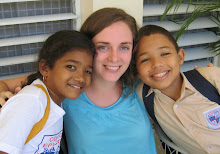
Health promoter just home from school


My census assistant in Los Conucos


Health promoters in Villa Faro

These guys sell melon on the road out of Quisqueya

Good advice in the tropics: Carry your shade with you


A cow.

Tuesday, May 20, 2008

Lost in Translation

My favorite recent ¨Lost in Translation¨ moment for you:


So at the park close to the grocery store there´s a little dance studio run by this family of three. Dad and Mom (stage names: El Fantasma [The Phantom] and La India [India]) are the owners and they teach salsa, merengue, and bachata. Their son, Landry, (who now all-of-a-sudden wants to be called exclusively by his stage name: El Fantasmito [the Little Phantom]) is 11 and a fabulous dancer/teacher. Anyway, this family is really great and I´ve been enjoying getting to know them and learning to dance over the past few months here in San Pedro.

I usually go to class with the daughter of some friends from work, and we´ve become good friends with Landry. But one day, my friend, Natalia, minorly cut her foot on some broken glass and couldn´t come to class for a couple days. When I arrived at class by myself, Landry met me at the door and asked me where Natalia was. I had prepared myself for this moment and thought of a sentence with all the right reflexive pronouns: Ella se cortó a su pie. (¨She cut her foot¨, or, literally: ¨She cut herself at the foot¨.) I smiled broadly and waved my hand to indicate that it was no big deal, all to be met by a gap-mouthed, wide-eyed stare from Landry who suddenly bursts out with: ¨They amputated her foot!?!?¨

Oops.

Confusion ensued as I tried to assure him that no, it was just a small cut on the arch of her foot, she would be fine, etc. I was also laughing pretty hard putting myself in Landry´s shoes, seeing my smiling non-chalance as I announced the amputation of our friend´s foot. (Hahahaha. Still funny.)

Anyway, it all got straightened out, Natalia´s foot healed just fine, and dance class continues to be a joy. But I still don´t know how to properly say, ¨She cut her foot¨.....

Thursday, May 8, 2008

Tough Call

[Warning/waiver: Hello, all. I have had to delete the initial opening paragraph to my post, which included general greetings and a brief outline of this last month’s activities, because, as I wrote the post, it didn’t follow that outline at all. Much to my surprise, what follows is an exploration of healthcare on two different levels. Also to my surprise, it has gotten late and I have to go to bed now. But rest assured that I will post more very shortly, and it will be less lengthy and have more pictures! Until then, here you are:]

During the past four weeks or so, we’ve been working on getting our community health program up and running in two new – and very different – communities. In El Brisal, named for its hill-top breezes, we’ve come up against a lot of obstacles. The community is rather new and hasn’t yet developed a well-organized neighborhood council. Our program policies require a strong leadership structure in the community, since a lack of one usually indicates a community unable to take on the responsibility of health promotion and illness prevention themselves. It’s not that people don’t want to be healthier, know more about fever and infection, or learn new water-treatment options – and it certainly doesn’t mean that they don’t deserve these things – it just usually means they are absorbed in the hard work of making their own lives move forward from day to day, and aren’t yet in a place stable enough to take part in an “extracurricular” activity like volunteer work. In El Brisal, we have tried five times to have our initial program-presentation meeting. We have started hours late; we have canceled because no one showed up to our well-publicized meeting; we’ve had people come to ask us to fix the electricity problems, the water problems, the inflation problems, the swamp and mosquito problems…. We have never had more than two people show enough interest or dedication to come to more than one meeting.

This raises a lot of issues I studied in undergrad on a theoretical basis, but turn out to be much more complicated in real life. Big surprise, right? One of these is the issue of healthcare on the individual versus group level. Currently, our healthcare in the United States is focused on the individual – we will pull out all the stops, use whatever tests and resources are available, simply do whatever it takes to see an improvement in the individual patient in front of us, all of which makes for inherently “treatment-focused” care. This kind of care comes with assumptions about unlimited resources, and measures its own efficacy on a case-by-case basis. (This all, of course, really mostly applies to the insured patient who can pay.) On the other hand, a public health approach focuses on the group level. Working under the assumption that there exist limits to healthcare resources, and that these limited resources should be used to achieve the greatest good, this type of care tends to be prevention-focused, and measures its efficacy based on group statistics like a decreased infant mortality rate in a given population.

Both individual- and group-level healthcare have pros and cons. Doing everything in your power to fix the sick person in front of you feels right (and is what we all want when we picture ourselves as the individual)… besides, what would healthcare really be like if tough, ethical, in fact “god-like,” decisions and judgments had to be made about who deserved what and how, where and when. But similarly: What if we worked to prevent the illness that required these drastic treatments, as we so often can? And as moral, caring, and perhaps religious people, aren’t we obligated to think of others, especially the underprivileged groups that are already experiencing a rationing of healthcare that we just don’t see? Lots to think about. And that was quite a crash course… please feel free to respond to/correct what I just described (especially since I’m not even sure if I still speak English anymore).

So back to the matter at hand: I work in community health, a group-level healthcare approach by definition. I have seen first-hand that there are not unlimited healthcare resources in this world. And I have seen first-hand some of the useless and wasteful effects of the individual-approach in this country, as I have seen incredible benefit from health education and preventative measures. But then there’s Kevin:


Kevin is the 14-month-old son of one of the two people who came to several of our meeting attempts in El Brisal. He is interactive and social, and his mother is a quiet, dedicated woman who believes in contributing her time to the benefit of her greater community. They both represent the many wonderful, deserving children and adults in this neighborhood. But she and Kevin – and the rest of El Brisal – will not benefit from our community health program (at least not yet) because the community doesn’t yet have the infra-structure to support it. On a personal level, it is unlikely that I will ever see them again. Isn’t that sad? Aren’t you feeling frustrated? I am.

But now listen to this: The other community where we have started implementing the program is about 15-minutes away (that’s a lot of gas-money, by the way) and is called Los Conucos. In terms of need, it is certainly in league with El Brisal. In fact, as we have discovered in completing our census, hardly anyone knows where to get a free, confidential HIV test, lots and lots of children simply aren’t vaccinated, most people don’t treat the cooking water they draw from their contaminated wells, and the concept of ever feeding an infant solely breast-milk is almost unheard of, let alone doing that for the recommended first six months. But Los Conucos has a well-organized and hard-working neighborhood council, which immediately understood and agreed with the premises of our program. In one meeting we enlisted the support of the community council. In the next we had 25 people interested in volunteering their time as a health promoter. And in the next, all 25 returned and spent half a day being trained in health promotion and getting their neighborhood assignments. In fact, this community is so organized that they have decided to kill two birds with one stone, and have gotten their high-schoolers interested in and committed to being health promoters, instead of hanging out on street corners and in bars. Isn’t that great?! Aren’t you feeling exhilarated?! I am!

Our first meeting with interested promoter candidates

Some high-schoolers stay after to read our Women´s Health manual

But now imagine that you have to choose between these two communities. In a very real and true-to-life scenario, imagine that the Community Health Program of La Clinica Esperanza y Caridad is low on funds. What am I saying, “imagine”? Haha. We do not have the resources to implement this program in every needy and deserving place. We are constantly making decisions like the hypothetical one before us now. In this situation, of course, the clear choice appears to be Los Conucos, where the community is equipped to become responsible for its health status/care, and you can already see the benefits of the program in effect. El Brisal may be ready at a later date, and perhaps we’ll have the funds by then.

But now imagine that the funds are there – now – to implement the program in both communities. So no one will miss out if you start the program in both places… for now. Is it responsible to expend the money, materials, staff, time, effort, on a community where it will most likely yield no result? Especially when it is likely that you can save the resources and use them on another community like Los Conucos? Again, it seems obvious that the responsible thing is to save the money….until you start thinking about the people like Kevin and his mother who will miss out on the information, and continue at higher risk for illness and even death. Don’t all people deserve a chance to be healthy and shouldn’t we do whatever is in our power to improve that chance?

Conveniently, it is part of program policies that we do not start the program and invest the resources in communities without a leadership structure. Phew. Looks like that tough decision has already been made for us. But as I continue in healthcare here and in life, as I engage in the decision-making, in the choosing of who gets and who doesn’t, I just feel pretty unequipped – despite “logic” and “good reasons.” I believe in prevention and community health, but communities are made up of individuals! I know these people. It’s hard.

So this has been long. And there is still so much more to say. I guess the nutshell is this: Life is full of complicated decisions. Healthcare is full of complicated decisions. But it is important that we identify them and think about them, even when there are no clear answers to be found, and even if we are not healthcare providers ourselves. And that’s where I’m stopping for today. I had had great plans for a long, vast post covering many aspects of work and daily life, but this post took a different course of its own. So now I’ll add a warning/waiver to the beginning before I publish it, and call it a night. Happy May everyone - I’ll trade you a mango for a small bouquet of Lilly of the Valley! Enjoy!

Saturday, April 5, 2008

Jose Update


Remember Jose? (You can see my September entry about this struggling baby here: http://saludosdekate.blogspot.com/2007/09/two-patient-stories.html) Look at how much better he's doing six months later!


Near-death six months ago, Jose has just turned a year old and he is alert, interactive, and starting to stand. He smiles and claps and reaches and does all kinds of things that are especially encouraging to those of us who met him last September. He is a beloved patient, and we are always excited to see him. He´s still on the small side, weighing about 16 pounds and he´s frequently in the clinic for persistent respiratory and appetite problems, but we´re rooting for him and believe he´ll continue to improve.

I thought this was going be a lengthy, somewhat ¨deep¨post, but really I think I can sum up what I want to say this way: There is nothing like working with a person over a period of months and watching his health improve. I certainly wasn´t Jose´s doctor or anything, but I weighed him, filled his meds and formula, listened to and relayed his parent-figure´s concerns, and just spent some time every week hanging out. And without even realizing it was happening, I got invested! And now every time I see him, I get this bubbly happy feeling inside because he´s holding his head up and smiling. Perhaps cliché, but certainly amazing.

I am thankful for: dedicated healthcare providers, generous neighbors, food donations, anti-retroviral medicines, charitable funds, donated baby bottles, HIV research, and so many other things that make Jose´s care possible. And thank you all for keeping him in your thoughts and prayers.

This really is just unbelievably wonderful.

Look who else I get to hang out with!


Saturday, March 29, 2008

Give me a V-A-C-C-I-N-E!

Hello! I’m writing today to tell you about our exciting vaccine workshop we just presented on Thursday. This is the first workshop where I’ve been left in charge of big chunks of the preparation and presentation of the material, so I’m particularly proud of it. (And now I also better appreciate the work that goes into giving a training workshop!) So now, I am pleased to present: The Birth of a Community Health Initiative.

First of all, remember in August and September when I described doing a door-to-door health census and making a map of Villa Faro to inform our newly-trained community health promoters there? Well, since then, these promoters have been visiting neighbors’ houses, checking on the sick and educating the well. We have presented workshops on potable water, HIV/STD’s, dehydration and diarrhea, respiratory illness, women’s health, and other topics. We’ve visited each promoter every other month or so to ask how visits are going and to sometimes accompany them. Overall, the Villa Faro Health Promotion program is in full swing and doing well.

But about three weeks ago it came time to think about giving the vaccine training workshop. We realized that our materials – our manual, posters, etc. – were out of date, and that we’d have to start from scratch in designing the workshop. Somehow the task of compiling a new manual fell to me, and I was left to sort through the government's public health nurse training manual, our old manual, and a medical dictionary…. all in Spanish, of course. I decided what from the public health manual was important to include and what was too technical; I updated the information in our old manual to include the new vaccines available and the new schemes in use; and I distilled the medical dictionary entries on each illness to give a basic overview of exactly what these vaccines are preventing. After I typed it up and the other two members of the team checked it, we were left with a simple, clear, 23-page manual on the importance of vaccines, how they work, special considerations, administration scheme, the preventable illnesses, and how to approach a family about vaccines and verify the children’s vaccine records. Our medical director added images, a cover page, and brought it back from the printer’s bound in shiny plastic and ready to go! Yes!


Then we decided to base our presentation on the manual, using the same topic order. We split the manual into four sections and each of us was responsible for organizing and presenting our chunk. Channeling middle school, I made a big chart showing all the vaccine information together for the presentation:
That poster earned me much admiration from the team and before I knew it I was making everyone’s posters, tracing pictures of babies, coloring with crayons, and block-printing definitions and lists. (Kids here don’t get much practice/play with construction paper, markers, rulers, and glue in school, so everyone is consistently impressed with my ability to print and color. It’s a reminder of the privilege I had even in elementary school – how sad that children miss out on that.)

The night before the presentation, I stood in front of the mirror and practiced my five-minute chunk over and over. It went something like this: Ah! I forgot the indirect object pronoun! My tongue catches on double “r” sounds! I can’t say “domiciliaria” and sound like a human! Ah! Ah! I could hardly sleep I was so nervous. In retrospect, it’s pretty funny. After years of presentations and performances, memorization and improvisation, I flip out over five minutes of common sense and spend an evening staring at my flip-flopping tongue in the mirror. Haha!

But the next day, I felt ready and excited. The day of passing out my lovely manual, showing off the beautiful posters, and doing my first chunk of group training in Spanish had arrived! My chunk was last, so I took pictures, prepared the snack, and helped with small-group activities until then.


In small groups, promoters brainstormed common reasons parents give for not vaccinating their children. These can include:

  • The last vaccine made my baby sick and gave him a fever, so we’re not going again.
  • All vaccines cause allergic reactions.
  • Grandma and I were never vaccinated and we’re still around, so why should I vaccinate my baby?
  • My baby has/had a cold/fever/spots in his mouth/diarrhea/etc.
  • It’s been too long since his last vaccine, so we shouldn’t finish them.

Groups presented their ideas and we talked about ways to address these concerns, and clarified questions about contraindications to vaccines. Did you know that a baby can be vaccinated even if he is sick, is taking medicine, is recuperating, is malnourished, has allergies, or is very behind on the vaccination scheme? Many people in our workshop didn’t.

During the afternoon, promoters learned vaccination methods, practiced reading various hypothetical vaccine records and identifying missing vaccines, and enjoyed a break:


Ten minutes before our scheduled ending time, it was my turn to present. I stood up and talked about how to interact with families during a home visit about vaccines. My favorite part, where I got to do some acting, was showing that it’s better to encourage rather than criticize. For example, it’s not a good idea to say: “Look! Your child is missing vaccines! You’re a terrible mother!!” (Here, the audience graciously chuckled – score one for Kate!) Rather, it’s better to say: “OK, here is evidence of part of the scheme; let’s talk about your plan for completing it.” I also emphasized that every home visit, whether it’s just a check-in or a requested visit to assess an illness, is a chance to talk about vaccines or to check a child’s vaccination record. When I asked at the end if everyone had understood me, they all smiled in an encouraging way and said, “Yes!” Wahoo!

We thanked people for coming, packed up the jeep, and headed back to the clinic. That evening, I reflected on all the hard work I’d put in to the presentation, and thought about all the work the rest of the team had done, delivering invitations, reserving the church space, organizing activities and buying supplies, and doing the majority of the presenting, in addition to all their regular clinic duties. Truly, I am so proud to be a part of this capable and dedicated team.

Next, we will start training promoters in new communities to follow the path of the Villa Faro group. We are currently gathering volunteers, doing our preliminary census, and making maps, but soon the program will begin in two new communities. And I’ve already been assigned a big chunk of the next presentation, most likely on how to be a health promoter. Here we go again!

I hope everyone had a peaceful Easter. Enjoy spring, and if you see a crocus, please say hello for me!

Friday, March 7, 2008

A Whirlwind Week

Hello! After some time away from the internet, I’m back and vowing to post more regularly.

I’ve just moved back to San Pedro and am finally moved in and into full swing in the HIV unit and with the community health team. Before the move, I was working in the rural town of Santana Bani (about two and a half hours away) preparing for and then translating for a visiting short-term medical team from western North Carolina. No amount of words can describe the experience, but I’ll give it my best shot and throw in some pictures for flavor.

Part I of my work, preparing for the team, proved a bigger job than I’d anticipated. I started simply by making nametags in Spanish for the Americans: Jim became Jaime, Ray à Raymundo, Joan à Joana, etc. In the days that followed I worked with two others to plan the clinic flow through the church and school building available to us: waiting room to intake to waiting room to exam room to pharmacy to parasite station to exit. We trained community volunteers, picked up meds, strung up sheets for examination areas, made signs, scrubbed bathrooms, and had countless conversations with willing and wonderful locals on how to ensure water, electricity, and working fans and toilets. Lesson learned: Always make friends with security guards and maintenance people.

Part II began when the team arrived to provide four days of free medical care. We had an ophthalmologist, three doctors doing general medicine, one physician’s assistant, one nurse practitioner, one paramedic, two nurses, a med student, a marketing analyst, a priest, a dance teacher, and an organist. Phew. Only two or three of those spoke Spanish, so I spent most of each day jumping from room to room translating. (I snuck some picture-taking in too.)

We saw about 180 patients each day and there still wasn’t time to see everyone. Our “waiting room” in the church sanctuary was full most of the time, as families gave their medical history to a volunteer or waited to be weighed.


These three kids waited patiently all morning - when I took this picture – but by the time I was translating for them and Mom at 11:30 they could no longer curb their curiosity over tongue depressors and stethoscopes. My pictures of them then all turned out blurry with movement, though I had a great time during that session.


We did exam after exam, until some things became so common the providers turned over explanation to me. Kate, please find out what they’re eating and do The Diet Spiel… Could you please do the Diabetic Foot Care Explanation? …. I need a Scabies Cream Tutorial over here! etc. OK, so maybe they didn’t use those exact words, but pretty close! In truth, I was lucky to be with a team of experienced providers who were excited to teach me new skills and talk through their diagnostic approach with me. For every patient I helped, I was helped in return, since everyone was willing to let me take a second listen to the lungs, watch an exam, or re-palpate a lymph node. A big thanks to all our providers and patients!


On February 27th, in the middle of our clinic week, the country celebrated Independence Day, so we spent the day watching parades and hanging out with the neighborhood folks.

I inadvertently ended up part of the parade, marching and waving a flag, and got a good view of family onlookers:


Now that the hubbub is over, reflections are starting to percolate through my brain. I can’t get over the huge amount of preventable or easily treatable illness, left un-checked, that we encountered every day. I saw adult after adult with hypertension and/or diabetes, and all the heart/foot/eye/body problems that go with them. I saw child after child with iron-deficient anemia and skin/digestive tract parasites. And then facing our own limitations to help as a short-term group: It’s hard to provide the necessary follow-up care for these chronic conditions. And what does it mean to give every child anti-parasite treatment when they’ll be back playing in the contaminated dirt and water next week?

When your advice is to drink less Coke, but drinkable water costs as much or more…. When you recommend monthly doctor check-ups but the nearest free clinic is often un-manned or out of meds…. When your instructions are to stay out of the dirt, but there’s nowhere else to play…. How can you help?

Sometimes I am overwhelmed by the incredible need in this country. The short-term clinic and my work here in San Pedro provide wonderful ways to concretely help people in these communities, even when it is the service of simply being with the people. Every time a child gets an iron supplement, a parent physical therapy, or an infant a vaccine, it is an important contribution. But I can’t help but feel the pull for infrastructural change, for running water, clean streets, health education, sewage systems, etc. These are big issues in a big picture, and I don’t have the background or skills to fairly address them, but I think it´s worth thinking about.

But for now I´ll close with a lighter anecdote: On Independence Day, after a morning of watching and marching in parades, two of us settled down under a tree with books. Suddenly I heard the clanging of spoons on pots and pans and turned to see about fifteen kids in all type of dress – though most with their underwear on their heads – yelling and marching our way. They swarmed around us jumping and laughing and yelling something about chicken, celebrating Independence and a day off school in their own unique way. Pretty soon, as spoons were dropped and participants´ underwear-hats became askew, we were all in hysterics. And then just as quickly, the kids waved and went back the way they came. Interactions like that, where language isn´t necessary and everyone is having a good time, are simply some of the most enjoyable. I still smile to think of Santana Bani´s Impromptu Parade.

That´s it for now, though there´s more on the way! Happy March, and have a great weekend!