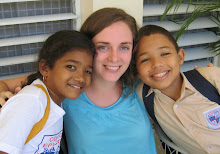
I'm particularly drawn to two regular patients at the clinic; we'll call them Jose and Carlos. We see both these babies often, including today, and I'd like to share their stories with you:
Jose is six-months old and weighs 8 pounds today. Last week when I weighed him he was 9 pounds, and the week before that he weighed 10 pounds - his caregiver told me today that he won't eat. Jose's HIV-positive mother abandoned him as a newborn, and he was taken in by an elderly neighbor woman and an uncle who are both very dedicated to his care. As a newborn, Jose was hospitalized five times in as many months before the public hospital referred him to our clinic. Fortunately, we can provide care (and some baby formula) to the family free of charge. Unfortunately, we don't have a big lab and cannot provide many of the complicated tests the baby needs, which means more expense for the family and lots of lost time waiting for results. We can't even do an HIV test, since the more affordable test we have would detect the mother's antibodies in the baby's system and be an automatic positive, no matter Jose's real status. Jose can't sit-up or grasp objects; he breathes poorly and his skin is covered in old and newer scabies scars. But he is alert, makes strong eye-contact, and loves to visually track moving objects. And he has the most wonderful, rare smile (that he usually reserves for his uncle). Holding this serious, tiny baby is unlike anything I've ever done before; my heart breaks for him. Jose is very, very ill. His failure to thrive is possibly due to a positive HIV status, but we can't start treatment until we get two separate, positive results of the expensive, out-sourced test - weeks of waiting. Today, we decided to put him in the hospital for a few days of IV nutrition. Please keep him in your thoughts and prayers - this baby needs all the help he can get.
Carlos is doing only a little better than Jose. At nine-months he weighs in at 14 pounds. His quiet, timid mother weighs 94 pounds (three pounds less than two days ago). She is HIV-positive, but Carlos has definitively tested negative, to everyone's relief. So why is Carlos' growth plateauing? He is a social and engaging child, with a sweet, elfin face and a quick smile. His mother says he eats a lot (rice, beans and even some meat, but almost no milk, which is too expensive and which we can't provide on the donor-program's technicality that Carlos is not HIV+). Mom hesitates to answer our questions; even when Elena, (with her open, non-judgmental, trustworthy, and caring manner) reaches out to her and gently explains how important it is for the baby to eat, and for Mom to eat, too. When Elena asks how things are at home, and if they have any food, Carlos' mother says yes and does not elaborate. Meanwhile, Carlos is malnourished, has chronic diarrhea, and failure to thrive. But, unlike Jose's failure to thrive, Carlos' seems nearly exclusively related to poverty - to little access to clean, affordable, and nutritious food and water, and to a parent who lacks a support-system and education to help her engage and care for her child, physically, mentally and emotionally. But there are encouraging moments: Carlos' mom returned my smile today. She wants to take care of her child, but doesn't really know how. I believe she is slowly warming up to us, which is the best way for us to care for both of them. Carlos and Mom: another family to keep in your hearts.
Even when I'm not at the clinic, I find these two sweet, small babies in my thoughts often. One baby probably HIV-positive and the other not. One with caring, dedicated, and persistent caregivers and the other with a single caregiver who's just starting to learn. Both families are fighting a difficult and terrible battle to raise their children. For me, both children are reminders of why I want to help and of what I need to do. Again, please keep them both in your thoughts and prayers.
Wednesday, September 26, 2007

Jarabacoa: the adventures continue...
This past long-weekend I went back up to the mountains in Jarabacoa with another woman from the clinic to do some more adventuring. And it was quite the adventure: Several different buses broke down during the weekend; I got on a horse for the third time in my life and ended up on a 20-minute gallop through the country-side with no real saddle and some bumps into trees and fences; I got on a river-raft for the second time in my life - we capsized in a rapid called The Toilet. (I spent a short time floating down-river, but luckily we were all fine.) But perhaps the best adventure came in the form of Manuel and Estrilo, two six-year-old cousins who were daring each other to get closer and closer to our cabin while I was reading. I went out to say hello and the boys and I became fast friends. The next day, more kids showed up at the camp. All of them are very familiar with digital cameras and very excited about photo-shoots. So here are some of our best shots:

 Estrilo and Manuel
 Part of the group (That fruit that everyone keeps eating is called guayava and is sort of like the Dominican apple)
 Girls only!
 Muchachos
 Group cart-wheel attempt
 Group shot
There are several other shots of eating cookies, climbing trees, swinging, and all that good stuff. These kids are enthusiastic about everything and great Spanish teachers! I had an amazing time riding horses, swimming in waterfalls, and rafting this weekend, but sometimes nothing beats some good old-fashioned hangin' around with the kids!

 Estrilo and Manuel
 Part of the group (That fruit that everyone keeps eating is called guayava and is sort of like the Dominican apple)
 Girls only!
 Muchachos
 Group cart-wheel attempt
 Group shot
There are several other shots of eating cookies, climbing trees, swinging, and all that good stuff. These kids are enthusiastic about everything and great Spanish teachers! I had an amazing time riding horses, swimming in waterfalls, and rafting this weekend, but sometimes nothing beats some good old-fashioned hangin' around with the kids!
Saturday, September 15, 2007
Work Update
Two months in the DR so far! We're having a quiet afternoon in the house. There's some dark clouds rolling in from the east - cross your fingers for a big storm to break this heat. Through my window I can see an animal trotting back and forth on the roof of a building in the next block. Is it a dog? A small goat? A large pig? No matter how hard I squint, I just can't tell.
It's been a while since I've written about work at the clinic, but there's still a lot of exciting things going on! I'd like to answer some FAQ's about the clinic and its services. There are four sections of offices: primary care, HIV/AIDS, physical therapy, and vaccinations/pharmacy/lab. Here's a "virtual tour":
Through the front door is a waiting room and long hallway with several primary care examination rooms and offices. The docs here treat injuries and infections, and do a little bit of prenatal care and a fair amount of gynecological care, though they don't deliver babies. A typical exam room is big and clean with open windows, a desk, and an exam table. Unfortunately, the rooms lack practical things like sinks. (A well-meaning charity didn't ask the docs what they needed before re-doing the rooms.) The best bathrooms are down this hall on the left. And if you time it right, you can walk past the door to the one air-conditioned room in the clinic while it's momentarily open. Great doctors and the occasional AC - the place to be!
The primary care/administration section takes up the short leg of the "L"-shaped clinic. The longer leg starts with the HIV/AIDS clinic, called Esperanza y Vida (Hope and Life) - my home base. In three rooms with green curtains and an ocean breeze, we do HIV testing, counseling, medicine distribution, and doctors' visits. Several of us double up as the community health team and also work out of this space, for lack of our own. We do programs like the Health Promoters in Villa Faro, education/support programs for at-risk groups, and regular home visits. Last week, we did a Health Promoters training session on fever and respiratory diseases and met with the neighborhood association to divide the Villa Faro map into promoter regions. I have to say, I think our section of the clinic has the most fun! We get to develop real relationships with our patients since they come regularly. They bring us their babies to play with and bags of limes from their yards, and we swing by their homes to check-in during the week and bring food or medicines. The staff is entirely young women, except the Drs. Dohn, and we trade language lessons during slower afternoons or sit together to plan Elena's wedding (coming up next month! Yay!). It's like a big extended family!
Down the hall is the physical therapy area. The therapists see a lot of people recovering from motorcycle/work accidents and strokes; and also quite a few babies and small children who need treatment for congenital problems. The kids don't like PT much, but, for some reason, they tend to quiet down when I'm around. (I like to think the children are soothed by my charming and magnetic personality, but more likely they're fascinated by my unusual face and the goofy Spanglish I speak to them.) The therapists have begun to call me in whenever there's a particularly fussy kid and I'm not busy, which I enjoy. And, to add to my role as Child-Soother, they're teaching me to do heat treatments and ultrasounds for pain relief on the patients! Time spent in physical therapy is a great way to practice Spanish, and I get to hang out with kids! A full rotation there might be in the works for later this year.
Finally, at the very end of the "L," are the vaccination room, the pharmacy, and the lab. I don't actually know much about these offices except that babies are often crying in the vaccination room, just like in the States. The pharmacy is very small - it was hoped that it might be a money-maker to help fund clinic needs, but very few of our patients are in a position to pay the full cost of medicine, so we give families the necessary meds and find our money elsewhere. Otherwise, these offices are a mystery. Maybe I should go explore them....
So that concludes our tour. There is a second floor with some offices and storage, but the roof is so hole-y and full of animals that we can't do any patient care or meetings up there. There's also a big, newer room upstairs for group meetings with a big air conditioner right next to a huge hole in the wall to the outside, which sort of defeats the purpose. That room isn't used much, though it has a pretty view of the ocean.
The clinic is a great place to work, with plenty of interesting things to see and do, and lots of ways to help. The people I work with are all incredibly nice and understanding, and we have a lot of fun together. Last week, we community health people received a big shipment of donated food to make our monthly food bags for patients. We formed an assembly line and loaded rice, sugar, pasta, tomato sauce, canned vegetables, salt, chocolate powder, beans, soup mix, toothpaste, laundry soap, and much more into plastic bags to hand out. It took half the clinic space and nearly a full day to do it, but we had fun! Here are some pictures:
 Diana, Ana, and I load food on one side...
 Stefanie, Elena, and Greysi load food on the other side...
 ...and, finally, some of the finished product!
It's been a while since I've written about work at the clinic, but there's still a lot of exciting things going on! I'd like to answer some FAQ's about the clinic and its services. There are four sections of offices: primary care, HIV/AIDS, physical therapy, and vaccinations/pharmacy/lab. Here's a "virtual tour":
Through the front door is a waiting room and long hallway with several primary care examination rooms and offices. The docs here treat injuries and infections, and do a little bit of prenatal care and a fair amount of gynecological care, though they don't deliver babies. A typical exam room is big and clean with open windows, a desk, and an exam table. Unfortunately, the rooms lack practical things like sinks. (A well-meaning charity didn't ask the docs what they needed before re-doing the rooms.) The best bathrooms are down this hall on the left. And if you time it right, you can walk past the door to the one air-conditioned room in the clinic while it's momentarily open. Great doctors and the occasional AC - the place to be!
The primary care/administration section takes up the short leg of the "L"-shaped clinic. The longer leg starts with the HIV/AIDS clinic, called Esperanza y Vida (Hope and Life) - my home base. In three rooms with green curtains and an ocean breeze, we do HIV testing, counseling, medicine distribution, and doctors' visits. Several of us double up as the community health team and also work out of this space, for lack of our own. We do programs like the Health Promoters in Villa Faro, education/support programs for at-risk groups, and regular home visits. Last week, we did a Health Promoters training session on fever and respiratory diseases and met with the neighborhood association to divide the Villa Faro map into promoter regions. I have to say, I think our section of the clinic has the most fun! We get to develop real relationships with our patients since they come regularly. They bring us their babies to play with and bags of limes from their yards, and we swing by their homes to check-in during the week and bring food or medicines. The staff is entirely young women, except the Drs. Dohn, and we trade language lessons during slower afternoons or sit together to plan Elena's wedding (coming up next month! Yay!). It's like a big extended family!
Down the hall is the physical therapy area. The therapists see a lot of people recovering from motorcycle/work accidents and strokes; and also quite a few babies and small children who need treatment for congenital problems. The kids don't like PT much, but, for some reason, they tend to quiet down when I'm around. (I like to think the children are soothed by my charming and magnetic personality, but more likely they're fascinated by my unusual face and the goofy Spanglish I speak to them.) The therapists have begun to call me in whenever there's a particularly fussy kid and I'm not busy, which I enjoy. And, to add to my role as Child-Soother, they're teaching me to do heat treatments and ultrasounds for pain relief on the patients! Time spent in physical therapy is a great way to practice Spanish, and I get to hang out with kids! A full rotation there might be in the works for later this year.
Finally, at the very end of the "L," are the vaccination room, the pharmacy, and the lab. I don't actually know much about these offices except that babies are often crying in the vaccination room, just like in the States. The pharmacy is very small - it was hoped that it might be a money-maker to help fund clinic needs, but very few of our patients are in a position to pay the full cost of medicine, so we give families the necessary meds and find our money elsewhere. Otherwise, these offices are a mystery. Maybe I should go explore them....
So that concludes our tour. There is a second floor with some offices and storage, but the roof is so hole-y and full of animals that we can't do any patient care or meetings up there. There's also a big, newer room upstairs for group meetings with a big air conditioner right next to a huge hole in the wall to the outside, which sort of defeats the purpose. That room isn't used much, though it has a pretty view of the ocean.
The clinic is a great place to work, with plenty of interesting things to see and do, and lots of ways to help. The people I work with are all incredibly nice and understanding, and we have a lot of fun together. Last week, we community health people received a big shipment of donated food to make our monthly food bags for patients. We formed an assembly line and loaded rice, sugar, pasta, tomato sauce, canned vegetables, salt, chocolate powder, beans, soup mix, toothpaste, laundry soap, and much more into plastic bags to hand out. It took half the clinic space and nearly a full day to do it, but we had fun! Here are some pictures:
 Diana, Ana, and I load food on one side...
 Stefanie, Elena, and Greysi load food on the other side...
 ...and, finally, some of the finished product!
Have a good week everyone!
P.S. To answer a question from last week: My camera stayed dry on the river hike because one of the leaders brought a big waterproof bag and carefully carried everyone's cameras/phones in it. Lucky, huh?
P.S. To answer a question from last week: My camera stayed dry on the river hike because one of the leaders brought a big waterproof bag and carefully carried everyone's cameras/phones in it. Lucky, huh?
Sunday, September 9, 2007
The Retreat
So, after a week of sleeping nine hours a night, doing laundry, and cleaning my room, I feel back on track after last weekend's retreat. The weekend was one of extremes; lots of ups and downs. The diocesan camp is beautiful, and there were many lovely new people to meet, but it was frustrating not to understand conversations, plans and instructions... and, I'll admit, I was struck with a little birthday homesickness when people kindly offered me fried plantain instead of cake last Saturday. And I had always thought cake wasn't all that important to me - it's funny to suddenly miss things like that!
On Saturday, we spent most of the day hiking in this beautiful mountain river, to finish with a swim at a big waterfall. Being unable to understand the plan, I first saw the river and thought, Well this is just a glorified Indiana creek! We started wading in and out of the water, moving upstream. Almost imperceptibly, the current grew faster and more and more rocks and rapids began to appear.

People began to slip in the water and grab each other for support. We passed a beautiful waterfall, cascading down the mountainside and into the river. Birthday photo-op: Here's to 23!

We hiked on and on; the water grew rougher with each step. As we alternated between fast rapids and water up to our chests, it became clear that the only way to get through would be to form chains. I learned the Spanish verb for grab right then and there, as everyone yelled at me to grab onto them and reached out their hands to link with me. We were in hysterics fighting our way upstream, clinging to rocks and to each other, and sometimes just waiting to get lifted from one spot to the next by the bigger guys in the group. I, still not understanding the plan, asked in awkward Spanish, "Are we going to return by the same route?" and was met with an uproar of laughter. In retrospect, that is a pretty funny idea!
We hiked this way for two hours. It would suddenly hit me, as I pushed through water, gripped huge boulders, or clambered through jungle plants: I, Kate, am fighting my way through a mountain river and the jungle of the Dominican Republic! Amaaaaaazing! It sounds corny, but there really are no words to describe that feeling of doing the unbelievable. After a while, the current grew so fast that we had to stay to the very edges of the river, where the sides of the mountain had crept in. Here, the river had carved out room for only itself. We pressed ourselves against the rock and inched forward for this final stretch (overhead view):

And after that last hurdle: The waterfall!

We met up with everyone's kids (who, needless to say, had not been part of the hike), and started to swim. Beautiful!


After another hour at the waterfall, we climbed a path up the side of the mountain and had a late lunch before going back to the camp to clean up and rest. I was exhausted, but happy!
The river hike was the ideal ice-breaker. And shrieking and laughing and helping were all things I could do without speaking Spanish! I noticed (and appreciated) how firmly people reached out to help me through the rough parts, even when I didn't ask. I noticed that when I said, "thank you," no one responded with the usual "you're welcome." And I noticed that when I helped people no one said "thank you" to me. It dawned on me that helping each other through the water wasn't a special favor, needing a thank you - rather, it was just what you did. I was touched to be a part of this, and relaxed into its reliability. What a wonderful way to usher in a new year!
Now, a week later, I have just run into two of my newfound friends at church. Even though the retreat was filled with both struggle and joy, it looks like it laid the way for many great new beginnings. Wahoo! Here's to rivers!
Have a great week, everyone!
On Saturday, we spent most of the day hiking in this beautiful mountain river, to finish with a swim at a big waterfall. Being unable to understand the plan, I first saw the river and thought, Well this is just a glorified Indiana creek! We started wading in and out of the water, moving upstream. Almost imperceptibly, the current grew faster and more and more rocks and rapids began to appear.

People began to slip in the water and grab each other for support. We passed a beautiful waterfall, cascading down the mountainside and into the river. Birthday photo-op: Here's to 23!

We hiked on and on; the water grew rougher with each step. As we alternated between fast rapids and water up to our chests, it became clear that the only way to get through would be to form chains. I learned the Spanish verb for grab right then and there, as everyone yelled at me to grab onto them and reached out their hands to link with me. We were in hysterics fighting our way upstream, clinging to rocks and to each other, and sometimes just waiting to get lifted from one spot to the next by the bigger guys in the group. I, still not understanding the plan, asked in awkward Spanish, "Are we going to return by the same route?" and was met with an uproar of laughter. In retrospect, that is a pretty funny idea!
We hiked this way for two hours. It would suddenly hit me, as I pushed through water, gripped huge boulders, or clambered through jungle plants: I, Kate, am fighting my way through a mountain river and the jungle of the Dominican Republic! Amaaaaaazing! It sounds corny, but there really are no words to describe that feeling of doing the unbelievable. After a while, the current grew so fast that we had to stay to the very edges of the river, where the sides of the mountain had crept in. Here, the river had carved out room for only itself. We pressed ourselves against the rock and inched forward for this final stretch (overhead view):

And after that last hurdle: The waterfall!

We met up with everyone's kids (who, needless to say, had not been part of the hike), and started to swim. Beautiful!


After another hour at the waterfall, we climbed a path up the side of the mountain and had a late lunch before going back to the camp to clean up and rest. I was exhausted, but happy!
The river hike was the ideal ice-breaker. And shrieking and laughing and helping were all things I could do without speaking Spanish! I noticed (and appreciated) how firmly people reached out to help me through the rough parts, even when I didn't ask. I noticed that when I said, "thank you," no one responded with the usual "you're welcome." And I noticed that when I helped people no one said "thank you" to me. It dawned on me that helping each other through the water wasn't a special favor, needing a thank you - rather, it was just what you did. I was touched to be a part of this, and relaxed into its reliability. What a wonderful way to usher in a new year!
Now, a week later, I have just run into two of my newfound friends at church. Even though the retreat was filled with both struggle and joy, it looks like it laid the way for many great new beginnings. Wahoo! Here's to rivers!
Have a great week, everyone!
Friday, August 31, 2007
On the Fly


Hi everyone! I'm sorry I haven't updated in a while - and that this update must be short and business-like.
House-keeping:
Some people have said that they are not getting the update emails I send out. It seems that the mass emails (at least for people using gmail) are sometimes getting directed to the Spam box, instead of the regular inbox. If you have not been receiving update emails with a link to this log, and suspect you should be, try checking your trash or spam boxes. You should be able to approve my emails and receive them in your regular inbox. If that still doesn't work, just let me know and I'll double-check that your email is included in the list.
Also, in response to some emails: I'm sad to admit that I don't know how the boy from the last entry was rescued. I just saw the aftermath. Sorry to leave you with such a mystery!
I want to say a big THANK YOU to everyone for your notes, emails, blog comments, etc. Even if it seems I am uninterested (or I don't reply quickly, etc.), I am so thankful for these communications from home. I'm starting to feel more and more settled here, but it's lovely to have some connection back home, too.
The last two weeks have been busy and engaging. We continue to work on our Health Promoters program in the clinic and it's picking up speed! I am currently running out the door to go to a retreat weekend up in the mountains for people ages 20-35. It's supposed to be cool and beautiful, with waterfalls, hiking, and horse-back riding at the diocesan camp. It should be a good chance to get to know people my age. But - I'll be honest - I'm sort of nervous. At home, meeting new people, making friends, and visiting new places are all pretty easy for me. But here, where I stand out and it's a struggle to communicate, that stuff takes a lot more work. It still surprises me how much mental preparation I have to do to feel ready for any event outside of the clinic. So, this weekend is me taking a deep breath and plunging in. It will be beautiful and a chance to see and do things I've never done before (and a great way to practice Spanish!), but it's still work and effort. I'm looking forward to that great feeling of accomplishment that comes only after trying something new and intimidating! I know going to this retreat is certainly not something I will regret. Here I go!
So, I will be sure to update you all with stories and pictures from the weekend. And, lest that last paragraph make you worry, let me assure you that I'm happily settling in and enjoying this adventurous year. In fact, there's a lot of things about settling in that make me inordinately happy. Some examples from this week include correct usage of the subjunctive and the word "Supongo," successful washing and line-drying of my clothes and sheets, and an invitation from my co-worker, Ana, to hang out next weekend! I go ahead and let myself be pretty thrilled with these small events - life is good! So now I'll close with a description of the pictures (above) from last Sunday, when the whole church went to the other side of the country for a day at a stunning beach. I was nervous about that day too, but came through it with new acquaintances (and a slight sunburn): a success to be sure.
[For some reason, I can't get the pictures to appear anywhere but on the top of my entry.... It doesn't help that this entire site is also in Spanish now that I'm in a Spanish network. Oh, well. Any advice is welcome.]
Love to all! Have a wonderful Labor Day weekend!
Saturday, August 18, 2007
A Saturday with Hurricane Dean
 A typical house in Villa Faro
 A combination of trash and the beautiful ocean (Villa Faro)
 Clothes drying on barbed wire outside a half-constructed home (Villa Faro)
 My family, from left to right:
Father Guelmy, Jayza (14-yo), Reyna, Claribel (19-yo)
Just before Jayza's graduation!
An entry written on Saturday, August 18 (posted later due to internet issues):
I'm hunkered down in my dim room, waiting for today's weather to pass. It looks like Hurricane Dean is blowing away from San Pedro, and we're just getting the edges. But there's a lot of rain beating on our aluminum shutters and the wind is literally howling! Surprisingly, the weather has made for a really fun day, since everyone's holed up in the house. We made homemade pizza for lunch, with onions, mushrooms, corn, ham, and oregano. Delicious! Jayza, the fourteen-year-old, has the equivalent of her junior high graduation today, so she is running around the house in curlers and hoping for less rain by the time of the ceremonies this evening. Tonight will be the first wearing of her new dress and shoes, which she proudly modeled two nights ago - gotta love an excuse to get dressed up!
Earlier this afternoon, Fr. Gulemy yelled to me that there was a rescue going on at the beach two blocks away, where two boys had been surfing and one was now stranded clinging to a buoy. The waves are too high for boats to be on the water, and everyone from the neighborhood was gathering at the shore to see how the boy would be retrieved. Half an hour later, Fr. Gulemy called me onto the porch to witness what he called a "Dominican tradition" - the streets chock-full of people leaving the beach after a successful rescue. He laughingly said, "A Dominican custom: where there is danger, go find it!" Nobody is working today because of the weather, but everyone will make it to the beach to see a daring water rescue. What an eventful day....
And now, The Week in Work:
The clinic has a great public health program that works to place local people in healthcare roles right in the community. Well-liked, responsible, and interested community members are recruited and taught basic healthcare and water usage information and how to make effective home visits. These volunteer "Health Promoters" serve as educators, sources of advice, and advocates for their local community. They are trusted by and accessible to their neighbors - and they know first-hand what it's like to live in the neighborhood - which makes them an invaluable bridge between the clinic and the community. The most recently trained Health Promoters are to be assigned regions of Villa Faro and given the results from our health census, including information on population, illness, pregnancies, etc. We did a workshop training for these H.P.'s two weeks ago, and finished the census this past week, so I thought this week would bring assignments and the start of the Villa Faro program!
Then I found out that there is no map of Villa Faro. Suddenly, assigning regions and giving meaningful geographic census information was really out of the question. So, there was nothing to do but make our own map! Compasses, addresses, pavement, streets with names, grids....oh, the things I have taken for granted! Dr. Dohn and I were lucky enough to start with (only slightly outdated) Google satellite pictures of the city, zoomed in extra close, printed, and taped together into a large scroll. Clutching those fuzzy pictures and a blank scroll, we drove and walked the southern half of the neighborhood, drawing solid lines for driveable roads and dotted lines for winding footpaths and impassable roads. We noted important landmarks: a church, a school, every "Colmado" convenience store, and a big abandoned hotel-type building. This week, we will hopefully finish with the north half of the neighorhood. Even though it's a long, hot process, it's fun (like a puzzle) and a great chance to talk to people in Villa Faro.
Before, I wouldn't have thought to link maps and medical care, even though maps are used everyday in healthcare in the US (e.g. ambulances, satellite healthcare sites, hospital transfers, even bills!). When you think about it, healthcare, governments, social services, religious communities...all of these are inextricably connected. A lot goes into quality healthcare! And I like the idea of a healthcare provider who can use many different skills, in addition to scientific and technical training, to care for his patients. What a wonderful challenge, to think outside the box, to tap into different talents and resources! We need a map. So we're making one. It's so far been an exercise in patience and creativity, but it will hopefully contribute to the improved health status of an entire community - plus, we're making a copy for the city as well.
This week has certainly flown past; today marks my first month in the DR! I really can't believe it - I still feel like I just got here. I'm happy and healthy and learning new things everyday! And now it's really started pouring again, so I should finish up in case we lose power. Love to all!
Friday, August 10, 2007
Villa Faro
I promised weeks ago to include a description of the nearby neighborhood where we're conducting our health census. Soooo, without further ado, here it is, in brief:
Named for a non-functional lighthouse on the shore, Villa Faro ("Lighthouse Village") is a neighborhood that stretches north from the Caribbean Sea toward the center of the city of San Pedro - only a sixty-second drive on a paved street from my house. There's a huge jolt when the Jeep we drive leaves pavement to drive on Villa Faro's muddy/dusty streets, bouncing on top of the reefs of dead coral that make up the ground beneath this neighborhood. There are no sidewalks, gutters, or drains; no running water, and only improvised electric lines strung from tree to tree. Homes mostly made of salvaged boards and corrugated tin line tributary paths that branch off the road. There can be 2-5 houses stacked unseen behind the house facing the street.
Yesterday, while working on a presentation about water access in Villa Faro, we stopped to get a picture of a water system belonging to a woman named Maria. Dr. Dohn's profession became apparent, and, suddenly, we were ushered into the house to check Maria's father, Melvin, who had undergone abdominal surgery for a hernia in April. We entered through a typical homemade fence of rusted tin and barbed wire, strung with drying clothes. Maria's family, like most, has a "well" - a hole dug through the coral to the (salt) water table below. Inside the house, there are holes in the tin roof and the concrete floors. Maria and her seven-year-old daughter and three-year-old son live in two rooms at the front of the "lot." Melvin lives in a third room off the back. He is lucky to have his own mattress and mosquito netting; most people in this neighborhood have to share. Fortunately, even though his surgical wound has opened up and not yet healed itself, Melvin is doing fine, with no signs of infection and plenty of antibiotics and dressings. He is in pain, though; we brought some Tylenol today to help.
After dropping off the Tylenol, we continued our health census, walking from house to house in Villa Faro and asking questions about water access/uses, family size, and incidence of child/infant diarrhea, cough, and respiratory infection. On afternoons like this, I work with Ana, a woman about my age and height, which makes us an approachable pair to kids running around the neighborhood. We often have a small entourage of kids in tow, curious about what we're doing. Today, we rounded a corner and were met by a group of about six 8- to 12-year-old boys playing baseball in the street. With no families in sight, one of the older boys volunteered to answer our questions for his household. We must've made quite the spectacle, because soon we were surrounded by jostling and laughing boys. And then came the questions about diarrhea. Already fairly giggly, that just sent the boys over the edge. And what can you do when you're up to your eyeballs in 10-year-old boys in hysterics about diarrhea? Nothing but join in! Needless to say, the suvey was over. But we all had a great time!
Afternoons spent in Villa Faro are simultaneously enjoyable and heart-breaking. I struggle to describe the complex relationships among love, poverty, laughter, illness, beauty, struggle, and hope. (I sat in front of a blank computer screen for days thinking through different descriptions and stories before I could write anything.) Despite - or maybe because of - this complexity, census afternoons have become a favorite part of my week. I know that when we're finished with the census (we're nearing the end now), I'll miss it, but the lessons I've learned and the experiences I've had will be with me forever. And, with our newfound information, we will begin a local preventative healthcare program! Vive Villa Faro! - and may better times soon come your way!
Named for a non-functional lighthouse on the shore, Villa Faro ("Lighthouse Village") is a neighborhood that stretches north from the Caribbean Sea toward the center of the city of San Pedro - only a sixty-second drive on a paved street from my house. There's a huge jolt when the Jeep we drive leaves pavement to drive on Villa Faro's muddy/dusty streets, bouncing on top of the reefs of dead coral that make up the ground beneath this neighborhood. There are no sidewalks, gutters, or drains; no running water, and only improvised electric lines strung from tree to tree. Homes mostly made of salvaged boards and corrugated tin line tributary paths that branch off the road. There can be 2-5 houses stacked unseen behind the house facing the street.
Yesterday, while working on a presentation about water access in Villa Faro, we stopped to get a picture of a water system belonging to a woman named Maria. Dr. Dohn's profession became apparent, and, suddenly, we were ushered into the house to check Maria's father, Melvin, who had undergone abdominal surgery for a hernia in April. We entered through a typical homemade fence of rusted tin and barbed wire, strung with drying clothes. Maria's family, like most, has a "well" - a hole dug through the coral to the (salt) water table below. Inside the house, there are holes in the tin roof and the concrete floors. Maria and her seven-year-old daughter and three-year-old son live in two rooms at the front of the "lot." Melvin lives in a third room off the back. He is lucky to have his own mattress and mosquito netting; most people in this neighborhood have to share. Fortunately, even though his surgical wound has opened up and not yet healed itself, Melvin is doing fine, with no signs of infection and plenty of antibiotics and dressings. He is in pain, though; we brought some Tylenol today to help.
After dropping off the Tylenol, we continued our health census, walking from house to house in Villa Faro and asking questions about water access/uses, family size, and incidence of child/infant diarrhea, cough, and respiratory infection. On afternoons like this, I work with Ana, a woman about my age and height, which makes us an approachable pair to kids running around the neighborhood. We often have a small entourage of kids in tow, curious about what we're doing. Today, we rounded a corner and were met by a group of about six 8- to 12-year-old boys playing baseball in the street. With no families in sight, one of the older boys volunteered to answer our questions for his household. We must've made quite the spectacle, because soon we were surrounded by jostling and laughing boys. And then came the questions about diarrhea. Already fairly giggly, that just sent the boys over the edge. And what can you do when you're up to your eyeballs in 10-year-old boys in hysterics about diarrhea? Nothing but join in! Needless to say, the suvey was over. But we all had a great time!
Afternoons spent in Villa Faro are simultaneously enjoyable and heart-breaking. I struggle to describe the complex relationships among love, poverty, laughter, illness, beauty, struggle, and hope. (I sat in front of a blank computer screen for days thinking through different descriptions and stories before I could write anything.) Despite - or maybe because of - this complexity, census afternoons have become a favorite part of my week. I know that when we're finished with the census (we're nearing the end now), I'll miss it, but the lessons I've learned and the experiences I've had will be with me forever. And, with our newfound information, we will begin a local preventative healthcare program! Vive Villa Faro! - and may better times soon come your way!
Subscribe to:
Posts (Atom)